This Tapo Door Sensor Mini review looks at the T110 as a small contact sensor for monitoring doors, windows, cabinets, and other things that open or close.
It can send phone alerts and trigger Tapo smart actions, but it requires a separate Tapo Hub and a secured 2.4 GHz Wi-Fi network.
Tapo T110 Sensor Review Summary
The quick verdict
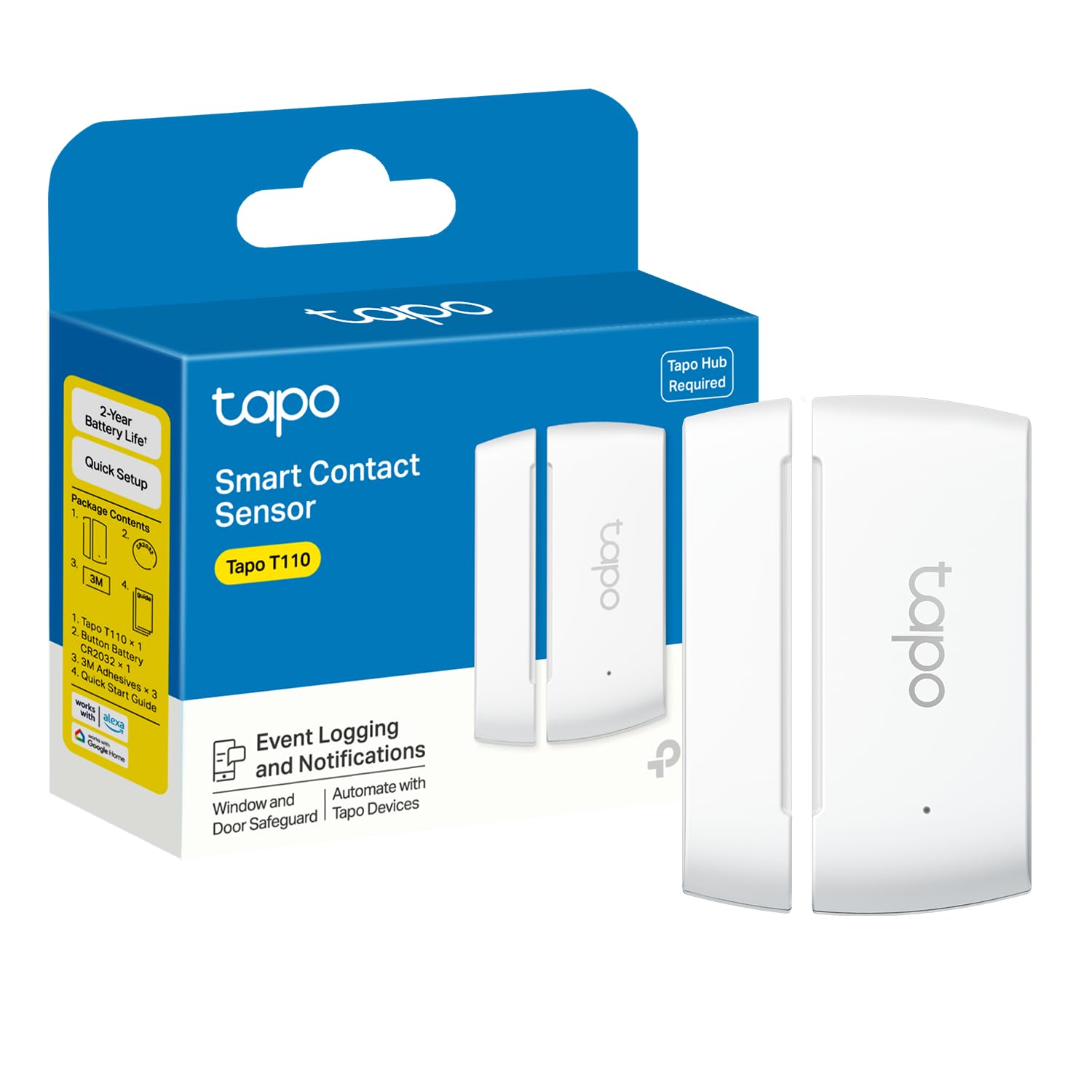
700+ ratings
Read Amazon ReviewsTapo T110 Door Sensor Mini
A fit for Tapo households that want door, window, or cabinet alerts and automations, provided they already have—or plan to add—the required hub.
- Requires a Tapo Hub, such as the H100, and a secured 2.4 GHz Wi-Fi network connection.
- Communicates with the hub using a Sub-1G low-power wireless protocol.
- Monitors doors, windows, cabinets, fridges, mailboxes, and other objects that open or close.
- Can send real-time phone notifications when a door or window opens unexpectedly.

Pros
- Useful beyond entry doors, with potential placements on cabinets, fridges, mailboxes, and other closable items.
- Can connect contact events to other Tapo devices through Smart Actions.
Consider before buying
- Requires a separate Tapo hub, so it is not a complete standalone monitoring setup.
- A secured 2.4 GHz Wi-Fi connection is also part of the required setup.
Read the full review summary
The Tapo T110 is designed to do more than report whether a door or window is open.
With the required hub, it can act as a trigger for smart actions such as switching lights or disabling a Tapo security camera when a door opens.
That makes it most appealing to people building a Tapo setup who want contact sensing to connect with other devices.
Its compact, adhesive-mounted design and included CR2032 battery make placement straightforward, while the stated battery life is up to two years at fewer than 30 triggers a day.
The key buying consideration is the hub requirement: this is a sensor for a compatible Tapo system, not a standalone alert device.
The buying factors
Tapo T110 Sensor Scorecard
Editorial scores reflect listed features and buyer fit; they are not laboratory measurements or customer ratings.
Smart-home automation
The sensor can serve as a precondition for Tapo Smart Actions, including lighting changes and camera control.
Placement flexibility
The contact sensor is intended for doors, windows, cabinets, fridges, mailboxes, and other open-and-close use cases.
Setup simplicity
Included adhesive helps with mounting, though setup also depends on a separately sold Tapo hub and Wi-Fi.
Battery outlook
The included CR2032 is rated for up to two years under the stated usage assumption of fewer than 30 triggers daily.
System dependency
A Tapo hub and secured 2.4 GHz Wi-Fi connection are required, adding a system prerequisite.
Alert flexibility
It supports phone notifications and can be configured to activate the hub siren, giving buyers more than one alert route.
Key Features and Specifications of Tapo T110 Sensor
- Requires a Tapo Hub, such as the H100, and a secured 2.4 GHz Wi-Fi network connection.
- Communicates with the hub using a Sub-1G low-power wireless protocol.
- Monitors doors, windows, cabinets, fridges, mailboxes, and other objects that open or close.
- Can send real-time phone notifications when a door or window opens unexpectedly.
- Can trigger Tapo Smart Actions, such as turning lights on or off or disabling a Tapo security camera when a door opens.
- Uses one included CR2032 battery, with up to two years of operation under the stated condition of fewer than 30 triggers per day.
- Mounts with the included 3M adhesive; the sensor allows a gap up to 15 mm.
Pros and Cons of Tapo T110 Sensor
Pros
- Useful beyond entry doors, with potential placements on cabinets, fridges, mailboxes, and other closable items.
- Can connect contact events to other Tapo devices through Smart Actions.
- Includes the battery and adhesive needed for basic installation.
- Up to two years of battery life is a useful target for buyers seeking low-maintenance sensing, within the stated usage conditions.
Consider before buying
- Requires a separate Tapo hub, so it is not a complete standalone monitoring setup.
- A secured 2.4 GHz Wi-Fi connection is also part of the required setup.
- The up-to-two-year battery estimate assumes fewer than 30 triggers per day; heavier use may change battery life.
Who Should Buy Tapo T110 Sensor?
Good fit
Consider the Tapo T110 if you already use Tapo devices and want door or window status to trigger useful actions.
A door opening could prompt a light change or interact with a Tapo camera, which makes the sensor more capable as part of a coordinated setup than as an isolated contact alarm.
It also suits buyers who want to monitor less obvious openings, such as a cabinet, fridge, or mailbox.
The adhesive mount and included battery help keep installation simple; before buying, confirm that your placement has room for the sensor and magnet to align with a gap of up to 15 mm.
For a household that needs several sensing points, check the hub capacity and alert behavior that fit your setup.
The H100 can connect up to 64 sensors and includes a siren with multiple tones, but the hub is a separate purchase.
Who should skip it
Skip this sensor if you need a standalone device that works without a Tapo hub. The T110 depends on that hub, along with a secured 2.4 GHz Wi-Fi network, for its described alert and smart-action functions.
Look elsewhere if you need a camera built into the monitored point or need a battery-life guarantee under frequent triggering. The T110 is a contact sensor, and its up-to-two-year estimate is tied to fewer than 30 daily triggers.
How the Tapo T110 Sensor Fits a Smart Home
Contact sensing with broader placement options
The T110 detects the open-and-close state of an item, so its value depends on where a contact sensor solves a real problem.
Doors and windows are obvious choices, but cabinets, fridges, and mailboxes can also benefit from a phone alert when their state changes. For less typical placements, check that the two sensor parts can align and stay securely mounted.
Automation is the main reason to choose it
The sensor can provide a condition for Smart Actions, linking an opening event to lights or a Tapo security camera.
That can make an ordinary contact sensor more useful in a Tapo household, though the specific action depends on the devices and setup you have.
Buyers should decide which response they actually want before adding sensors around the home.
Hub and network are essential setup pieces
The T110 communicates with the hub over a Sub-1G low-power wireless protocol, while the setup requires a Tapo hub and secured 2.4 GHz Wi-Fi.
The hub is also the point that can provide a siren response; the H100's described capacity is up to 64 sensors. Factor the hub into the overall setup if you do not already own one.
Battery estimate depends on activity
The included CR2032 is specified for up to two years when the sensor is triggered fewer than 30 times per day.
That gives buyers a useful planning estimate for ordinary monitoring, but frequently opened doors or cabinets can exceed the assumption. Consider how often the chosen item is used when deciding whether this maintenance profile suits you.
Alternatives to Tapo T110 Sensor
No alternative model is recommended here. Compare the design and features that matter to your routine before choosing another option.
Is Tapo T110 Sensor Worth It?
The Tapo T110 Door Sensor Mini is worth considering for people who want contact alerts and simple automations inside a Tapo smart-home setup.
Its flexible placement, included battery, adhesive mounting, and up-to-two-year battery estimate make it a practical fit for doors, windows, and smaller openings.
Buy it if you have or intend to add the required Tapo hub and can use the sensor's event to trigger a useful notification or smart action.
If you want a standalone sensor, or do not want the hub and network dependency, this model is not the right fit.
Your review at a glance
700+ ratings
Read Amazon ReviewsTapo T110 Door Sensor Mini
A fit for Tapo households that want door, window, or cabinet alerts and automations, provided they already have—or plan to add—the required hub.
- Requires a Tapo Hub, such as the H100, and a secured 2.4 GHz Wi-Fi network connection.
- Communicates with the hub using a Sub-1G low-power wireless protocol.
- Monitors doors, windows, cabinets, fridges, mailboxes, and other objects that open or close.
- Can send real-time phone notifications when a door or window opens unexpectedly.